

Get your daily news on science and technology
Provided by AGP
Tibet’s Thawing Lakes Accelerate Greenhouse Gas Release
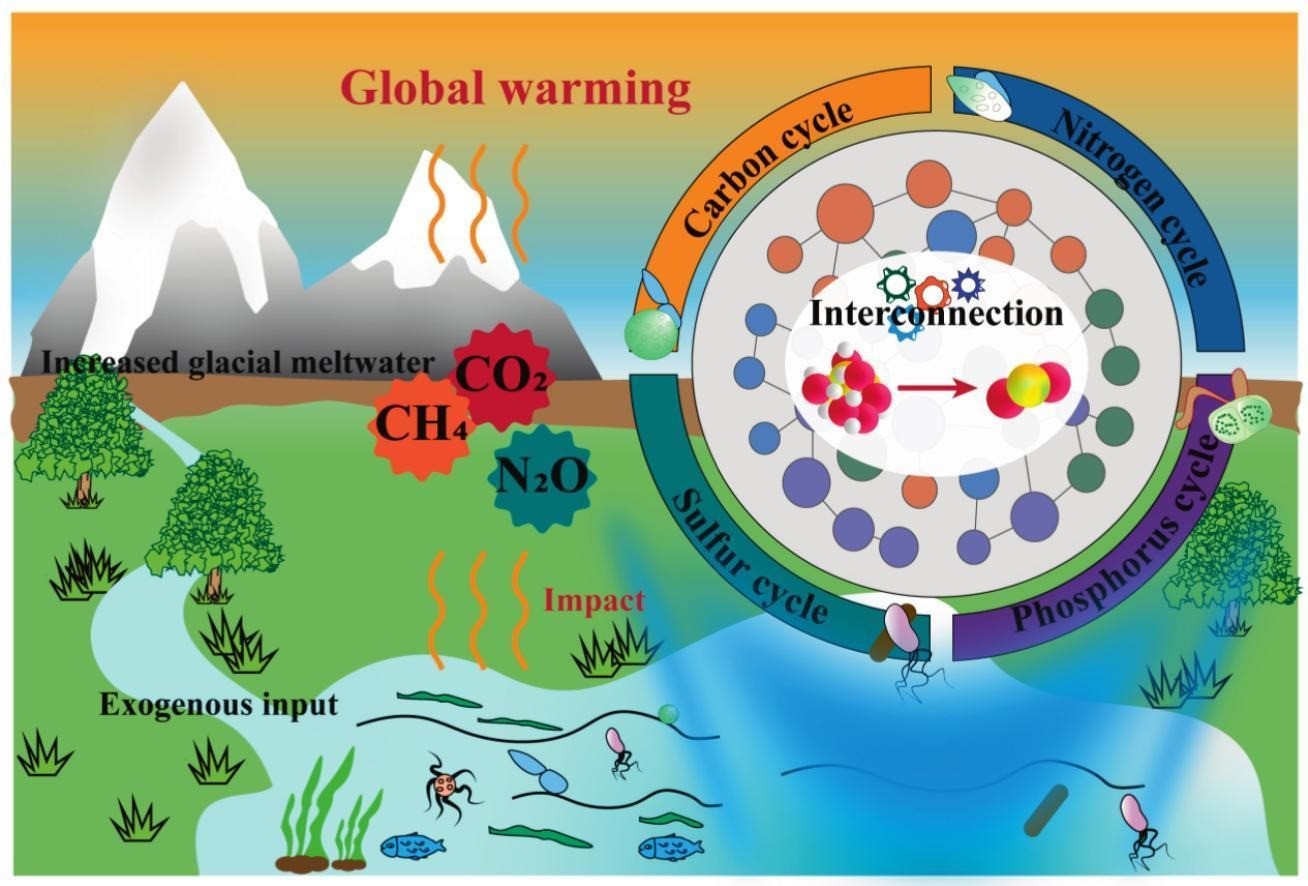
Graphical abstract.
GA, UNITED STATES, May 19, 2026 /EINPresswire.com/ -- A new review synthesizes research on Tibetan Plateau lakes, revealing that climate warming is turning these high-altitude ecosystems into major greenhouse gas sources. Melting permafrost and retreating glaciers feed thermokarst lakes, which are hotspots for methane emissions. The study calls for new models that include microbial mechanisms to predict and manage these emissions.
Lakes on the Tibetan Plateau are undergoing a dramatic transformation; once stable carbon sinks, they are rapidly becoming significant sources of greenhouse gases due to climate warming— the main takeaway from a new review published in Watershed Ecology and the Environment.
The study, which analyzed nearly 400 scientific papers, reveals that rising temperatures are accelerating permafrost thaw and glacier retreat. This process feeds the expansion of “thermokarst” lakes—new water bodies formed by melting permafrost. These lakes are critical hotspots, as they release ancient, long-frozen carbon as both carbon dioxide (CO2) and, more critically, as methane (CH4), a greenhouse gas 28 times more potent than CO2.
“Our review shows that the role of these plateau lakes is not uniform,” says Dr. Yang Liu, the corresponding author of the study. “They have differentiated into distinct types, ranging from significant carbon sinks to powerful carbon sources. This finding underscores the urgent need to move beyond simple assessments and adopt typology-based management strategies.”
The research, which provides critical scientific support for regional green development and global carbon neutrality strategies, turning what were once “neglected carbon sources” into “manageable carbon sinks, highlights the central role of microorganisms, which act as the “core engine” driving these emissions. Microbes decompose organic matter and cycle key nutrients like carbon, nitrogen, and sulfur. Notably, while warming extends the growing season for algae (which absorb CO2), it simultaneously supercharges microbial decomposition. This dual effect risks flipping the entire system from a net carbon absorber to a net emitter, creating a dangerous positive feedback loop that exacerbates global warming.
The authors call for an integrated, multi-factor model that incorporates microbial functional genes, nutrient coupling, and climate drivers. “Such a model would allow for “lake-type zoning” management—protecting lakes that remain carbon sinks while mitigating emissions from thermokarst and other high-emitting lakes,” adds Liu.
References
DOI
10.1016/j.wsee.2026.03.001
Original Source URL
https://doi.org/10.1016/j.wsee.2026.03.001
Funding information
This work was supported by the Key Project of the Natural Science Foundation of Xizang Autonomous Region, China (Grant No. XZ202301ZR0055G), the Science and Technology Projects of Xizang Autonomous Region, China (Grant No. XZ202502JD0025), the National Natural Science Foundation of China (Grant No. 32360629), and the Open Project of the Key Laboratory of Biodiversity and Environment on the Qinghai-Tibet Plateau, Ministry of Education (Grant No. KLBE2025006).
Lucy Wang
BioDesign Research
email us here
Legal Disclaimer:
EIN Presswire provides this news content "as is" without warranty of any kind. We do not accept any responsibility or liability for the accuracy, content, images, videos, licenses, completeness, legality, or reliability of the information contained in this article. If you have any complaints or copyright issues related to this article, kindly contact the author above.
