

Harnessing sound and sunlight: A new catalyst wipes out persistent pharmaceutical pollutants
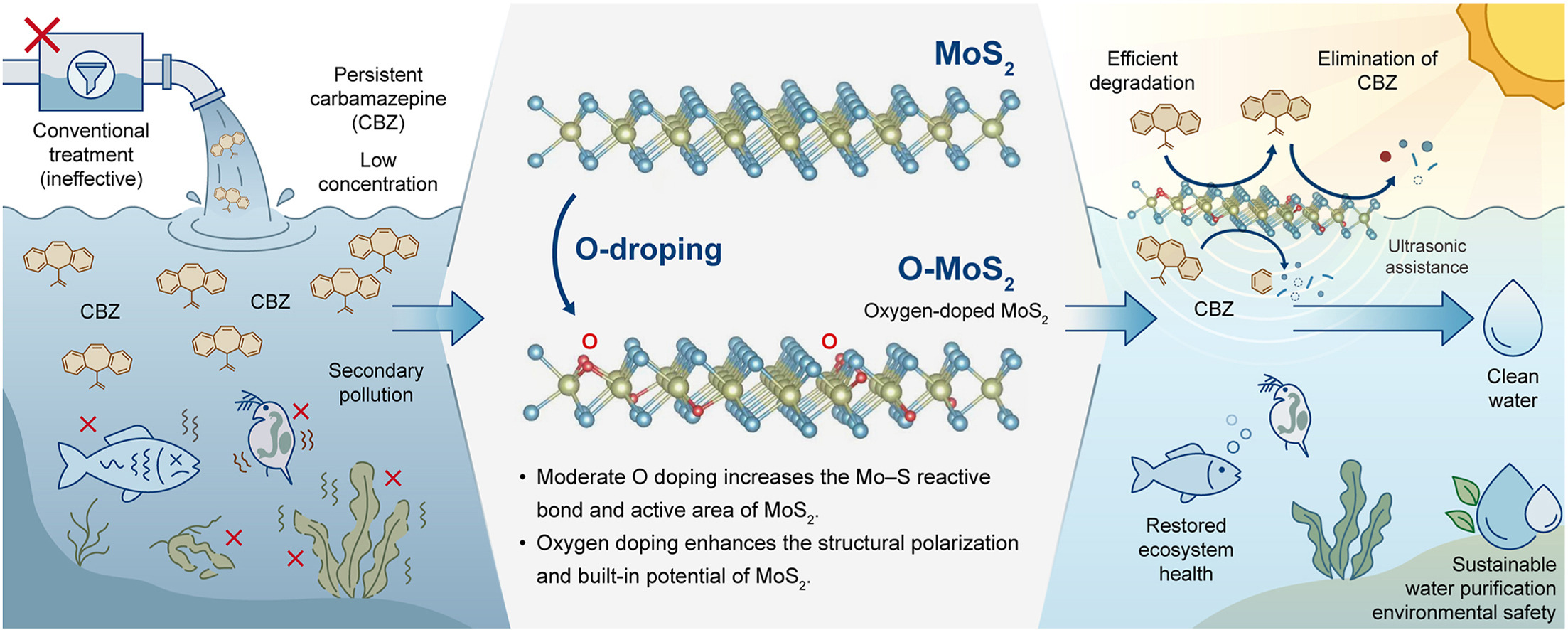
Oxygen-Doped MoS₂ Enables Rapid Piezo-Photocatalytic Removal of Carbamazepine.
GA, UNITED STATES, January 6, 2026 /EINPresswire.com/ -- Persistent pharmaceutical residues such as carbamazepine are increasingly detected in natural waters, posing long-term ecological and human health risks due to their resistance to conventional treatment processes. This study demonstrates a highly efficient strategy that combines mechanical energy and visible light to accelerate pollutant degradation using oxygen-doped molybdenum disulfide. By precisely introducing oxygen into the catalyst structure, the system achieves rapid and complete removal of low-concentration carbamazepine while maintaining excellent stability and low secondary pollution risk. The work reveals how defect repair and enhanced charge separation synergistically boost catalytic performance, offering a promising solution for sustainable water purification driven by multiple ambient energy sources.
Pharmaceutical contaminants have become a growing concern in aquatic environments because of their continuous input, low environmental concentrations, and poor biodegradability. Carbamazepine, a widely used antiepileptic drug, is frequently detected in surface water, groundwater, and even drinking water, where it can induce toxic effects in aquatic organisms and potentially impact human health through long-term exposure. Conventional treatment technologies often struggle with low efficiency, high energy demand, or secondary pollution when addressing such persistent compounds. Advanced oxidation processes show promise but remain limited by charge recombination and single-energy dependence. Based on these challenges, there is a clear need to develop advanced catalytic systems capable of efficiently degrading carbamazepine under environmentally realistic conditions.
Researchers from Chinese Research Academy of Environmental Sciences, Beijing University of Chemical Technology, and Dalian Jiaotong University report a new piezo-photocatalytic material that dramatically improves the removal of carbamazepine from water. Published on December 8, 2025, in Environmental Science and Ecotechnology, the study shows that oxygen-doped MoS₂ can completely degrade carbamazepine within minutes when ultrasound and visible light are applied simultaneously, outperforming conventional photocatalytic approaches.
The research team synthesized a series of oxygen-doped MoS₂ catalysts using a hydrothermal method, enabling precise control over oxygen substitution at sulfur vacancy sites. Among them, an optimally doped material exhibited exceptional performance, fully degrading 2 mg L⁻¹ carbamazepine in just 25 minutes under combined ultrasound and visible-light irradiation. The observed reaction rate was more than eleven times higher than that of undoped MoS₂.
Spectroscopic and electrochemical analyses revealed that oxygen doping narrows the bandgap, extends visible-light absorption, and significantly enhances piezoelectric properties. The optimized catalyst displayed a piezoelectric coefficient more than twice that of pristine MoS₂ and generated a stronger built-in electric field under mechanical stimulation. This internal field effectively drives the separation of photogenerated electron–hole pairs, suppressing recombination and increasing reactive oxygen species generation.
Density functional theory calculations further confirmed that oxygen atoms preferentially occupy sulfur vacancies, stabilizing the lattice while increasing charge polarization. As a result, superoxide radicals and singlet oxygen became the dominant reactive species responsible for carbamazepine degradation. Importantly, the catalyst maintained full efficiency over multiple cycles, showed minimal metal leaching, and significantly reduced the toxicity of degradation products, highlighting both its durability and environmental safety.
"This work demonstrates how subtle atomic-level modifications can fundamentally change catalytic behavior," said one of the study's senior authors. "By using oxygen doping to simultaneously repair defects and enhance polarization, we created a catalyst that efficiently converts mechanical and solar energy into chemical reactivity. The strong synergy between piezoelectricity and photocatalysis allows rapid pollutant removal at environmentally relevant concentrations, which is essential for real-world water treatment applications."
The findings provide a practical pathway for designing next-generation water purification technologies that operate efficiently under mild conditions using multiple renewable energy inputs. Piezo-photocatalytic systems based on defect-engineered materials could be integrated into decentralized or low-energy treatment facilities, particularly in regions lacking advanced infrastructure. Beyond carbamazepine, the catalyst also shows promise for degrading other antibiotics and organic pollutants, suggesting broad applicability. By linking material structure, electronic behavior, and catalytic performance, this study offers valuable design principles for scalable, stable, and environmentally friendly remediation technologies.
References
DOI
10.1016/j.ese.2025.100639
Original Source URL
https://doi.org/10.1016/j.ese.2025.100639
Funding information
This work was supported by the National Natural Science Foundation of China (Grant No. 52270055) and the Fundamental Research Funds for the Central Universities (Grant No. BUCTRC202209).
Lucy Wang
BioDesign Research
email us here
Legal Disclaimer:
EIN Presswire provides this news content "as is" without warranty of any kind. We do not accept any responsibility or liability for the accuracy, content, images, videos, licenses, completeness, legality, or reliability of the information contained in this article. If you have any complaints or copyright issues related to this article, kindly contact the author above.
